

PSD3 and PSR: the new EU payments framework
The EU is reforming its payments framework through the third Payment Services Directive (“PSD3”) and the Payment Services Regulation (“PSR”). The distinction is straightforward: PSD3 addresses who may provide payment services and how firms are authorised and supervised. The PSR sets out how those services must be provided.
Together, PSD3 and the PSR build on PSD2 and bring the payment services and electronic money frameworks together.
For firms, the changes have practical implications for authorisation, fraud prevention, customer protection and open banking.
Following publication of the final compromise texts, PSD3 and the PSR are expected to be formally adopted in late 2026.
The two instruments are intended to strengthen EU payment services rules and reduce differences in requirements across Member States:
- Third Payment Services Directive (“PSD3“): Sets out authorisation, prudential, governance and supervision requirements for payment institutions and electronic money institutions. As a directive, PSD3 must be transposed into each Member State’s national law.
- Payment Services Regulation (“PSR“): Sets out conduct-of-business requirements for payment services, including transparency, strong customer authentication, fraud liability and the rights and obligations of payment service users and providers. As a regulation, the PSR will apply directly across Member States without requiring national transposition.
In practice, firms will need to consider what the changes mean for their permissions, fraud controls, liability arrangements and open banking services.
What should firms do now?
Firms do not need to wait to start preparing. An early assessment of the implications for their business can help identify the changes that will require the most time and resources.
Matheson’s Financial Institutions team can support firms in navigating the transition to PSD3 and the PSR, from assessing authorisation requirements and changes to conduct obligations to reviewing contractual arrangements and developing a practical implementation plan. Our advice is tailored to each firm’s business model, regulatory status and priorities, helping firms identify the steps they need to take and prepare for the new framework.
Practical steps include:
- Review permissions and regulatory scope. Assess the firm’s business model, permissions and payment flows to identify authorisation and transitional requirements. Include electronic money activities and any exemptions currently relied on.
- Review fraud and complaints arrangements. Assess transaction monitoring, incident response, reimbursement and complaints handling. Consider where policies, customer communications, staff training and liability arrangements may need to change.
- Assess authentication and open banking arrangements. Review authentication methods and accessibility, together with any relevant open banking interfaces and access arrangements. Identify technology changes and dependencies on external providers.
- Review third-party contracts. Focus on responsibilities for authentication, fraud prevention, service availability, incident reporting and liability, and identify agreements that may need updating.
- Assign clear ownership. Bring legal, compliance, risk, technology, operations and customer-facing teams together. Map dependencies and develop a phased implementation plan that can be refined as the timetable and detailed requirements are confirmed.
Supporting you on your PSD / PSR readiness journey
Subscribe to receive our downloadable PSD / PSR Tracker and to stay informed with regular updates from our expert team.
Subscribe to updates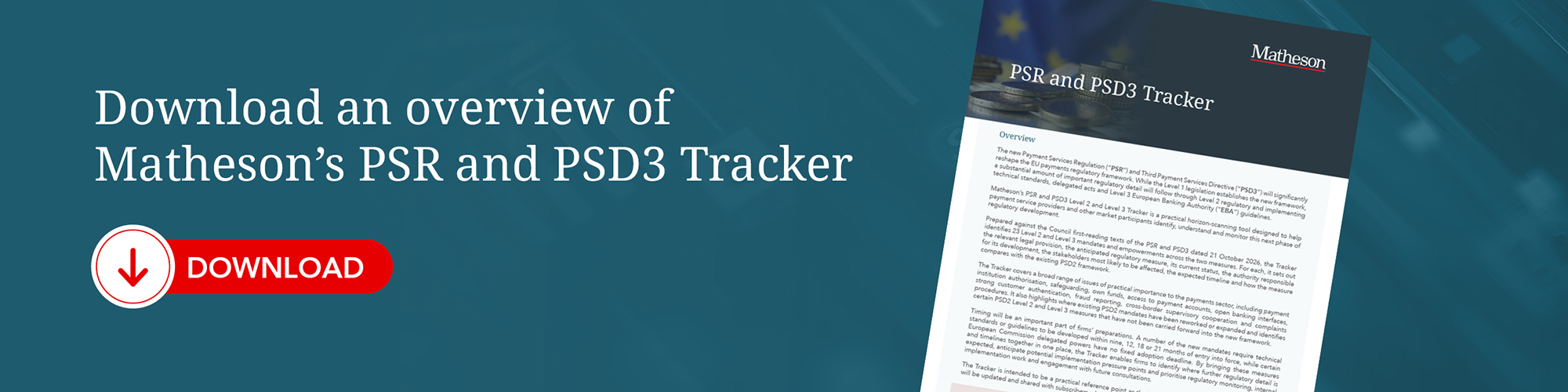


PSD3 and PSR: FAQs
The requirements will apply in stages. Under the timetable in the compromise texts, the PSR’s general requirements will apply 21 months after entry into force. Certain provisions, including the expanded verification-of-payee requirements, will apply after 27 months.
PSD3 must be transposed into national law by each Member State. Separate transitional arrangements allow eligible existing payment institutions and electronic money institutions to continue providing their authorised services for 27 months after PSD3’s entry into force, subject to the applicable conditions.
Consumers benefit from three main avenues of protection against payment fraud: refund rights for unauthorised payments; verification-of-payee safeguards to help prevent payments being sent to the wrong recipient; and specific refund rights where a fraudster impersonates the consumer’s payment service provider and tricks them into authorising a payment. Each avenue is subject to its own conditions and limitations.
Verification of payee checks whether the intended recipient’s name matches the account identifier provided before the payer authorises a credit transfer. If the details do not match, the payer’s payment service provider must warn them of the risk of sending funds to the wrong recipient. Where there is a close match, the provider must indicate the name associated with the account.
The PSR builds on the verification-of-payee regime introduced by the Instant Payments Regulation, extending its scope beyond the existing euro-transfer framework. It also provides for reimbursement where a provider’s failure to comply with the verification requirements results in a payment being sent to the wrong recipient.
Technical service providers and payment scheme operators can be liable to payment service providers for financial loss caused by a failure to provide services necessary for strong customer authentication. The liability is proportionate to the failure and capped at the amount of the individual transaction. It can arise even where the customer authorised the payment.
This does not remove the payment service provider’s own responsibility for applying strong customer authentication. Where a technical service provider supplies and verifies authentication elements, the payer’s payment service provider must have an outsourcing agreement in place. It retains full liability for failures to apply strong customer authentication, together with rights to audit and control the relevant security arrangements.
The PSR requires payment service providers to offer customers at least one free method of strong customer authentication suited to their circumstances. This includes customers with disabilities, older people, those with limited digital skills and those without access to digital channels or payment instruments. Providers must explain the available authentication methods and offer assistance where needed.
Authentication must not depend exclusively on a smartphone or other smart device, unless the customer has agreed to receive services exclusively through mobile applications on that device.
EMD2 will be repealed as part of the reforms. Its framework will be brought together with the payment services regime: PSD3 will govern authorisation and prudential requirements, while the PSR will set out conduct-of-business rules for payment services and electronic money activities.
Although the regimes are being combined, requirements specific to electronic money activities will remain, including rules for calculating own funds. A firm’s authorisation will also remain limited to the services it intends to provide.
Existing institutions will need to demonstrate compliance with PSD3’s revised authorisation requirements. The transition is not intended to involve a full application from scratch, but firms will need to provide the information required to assess compliance and determine whether their existing authorisation should continue.
Automatic authorisation is available where the NCA already has sufficient evidence of compliance. Firms should nevertheless identify any gaps early and prepare the information their authority will need.
Firms currently relying on an exemption or exclusion should carefully assess whether their activities and arrangements will continue to meet the relevant conditions. For marketplaces and retailers, two areas warrant particular attention: the commercial agent exemption and the limited network exclusion.
Commercial agent exemption (“CAE“). The agreement must give the agent real scope to negotiate or conclude the underlying transaction on behalf of the party it represents. E-commerce platforms acting for both the buyer and the seller cannot rely on the exemption. Simply describing a platform as an “agent” in the contract is not enough.
Limited network exclusion (“LNE“). The PSR clarifies the scope of the exclusion, including references to physical premises or online stores and use within a single limited network. Retailers and other firms should review the payment instruments they offer, where those instruments can be used and the participating network. Existing reliance on the LNE should not be taken for granted.
The practical starting point is to review contracts, payment flows and how the model operates in practice. Where reliance on either exemption is uncertain, firms should consider whether authorisation, a change to their operating model or an arrangement with an authorised payment service provider may be appropriate.
The interaction centres on clarifying regulatory boundaries and avoiding unnecessary overlap between the frameworks governing traditional e-money payments and crypto-assets. PSD3 and the PSR seek to delineate where MiCAR ends and the payments framework begins.
Under the updated framework, MiCAR-regulated issuers of electronic money tokens (“EMTs”) will not need separate authorisation under PSD3 solely to issue those tokens, provided that they are already authorised as crypto-asset service providers (“CASPs”) or EMT issuers. Separate authorisation will, however, be required if they also provide standalone traditional payment services outside MiCAR’s scope.
Where a CASP applies to its national competent authority (“NCA”) for authorisation under the PSD3/PSR framework to provide payment services exclusively involving EMTs, the NCA must decide on the application within 60 business days of receiving all required information. Any authorisation granted through this process will be limited to the services specified in the application.
Legislative discussions and EBA recommendations also seek to expressly exclude payment transactions undertaken solely to execute trading and settlement services involving EMTs from the PSD3/PSR conduct requirements, provided those transactions are handled by an authorised CASP.